
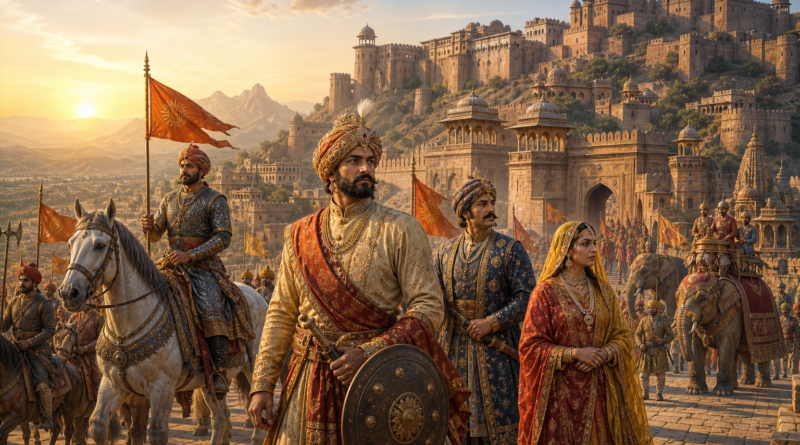
Rajput History: Origins, Kingdoms, Dynasties, Rulers and Rajputana
Editorial note: No verified sources were supplied with the research brief for this article. The overview below therefore avoids precise claims that require source-level confirmation and clearly identifies traditions, scholarly interpretations and disputed questions. It should not be treated as a fully cited academic history.
Quick Answer
Rajput history is the history of diverse ruling houses, warrior lineages and regional communities that became prominent across northern, western and central India. Rajput identity did not arise from one universally established ancestor or event. Most modern historical interpretations describe it as developing over several centuries through kingship, military service, control of land, political alliances, kinship traditions and the incorporation of different local elites.
The region later called Rajputana broadly covered much of present-day Rajasthan, although Rajput political and cultural influence extended into neighbouring regions. Rajputana was never one unified Rajput kingdom. It contained many states, including Mewar, Marwar, Amber or Jaipur, Bikaner, Jaisalmer, Bundi and Kota, whose rulers sometimes cooperated and sometimes competed.
Rajput history includes celebrated resistance, battlefield courage and defence of sovereignty, but it is not only a history of war. Rajput courts also shaped administration, diplomacy, architecture, water management, painting, literature, religion and trade. Their enduring heritage can be seen in forts such as Chittorgarh, Kumbhalgarh, Mehrangarh, Amber and Jaisalmer.
Key Facts About Rajput History
- Rajputs comprise diverse clans, dynasties and regional communities rather than a single uniform lineage.
- Rajput identity developed over time; historians continue to debate its precise origins and chronology.
- Several early medieval dynasties are later associated with Rajput history, although applying a fully developed later identity to every early ruler can be anachronistic.
- Major Rajput-ruled states included Mewar, Marwar, Amber or Jaipur, Bikaner, Jaisalmer, Bundi and Kota.
- Rajput relations with the Delhi Sultanates, Mughal Empire, Maratha powers and British authorities included warfare, negotiation, alliance, imperial service, tribute and treaties.
- Rajput courts supported forts, palaces, temples, stepwells, manuscripts, music, literature and influential schools of painting.
- Clan genealogies may combine inscriptions, chronicles, bardic memory and later reconstruction. A shared surname does not prove one universal genealogy.
Who Are the Rajputs?
The word Rajput is commonly connected with the Sanskrit expression rajaputra, meaning “son of a king” or “prince.” Its historical social meaning, however, was broader and changed over time. Rajputs came to be associated with hereditary rulership, military leadership, landholding, service to courts and membership in recognised clans or lineages.
This identity was neither static nor identical in every region. Political success, royal service, marriage networks, control of territory and claims to honourable descent could all contribute to the formation or recognition of lineages. Different branches developed their own histories and customs. Consequently, the terms vansh, clan, gotra and surname should not be treated as interchangeable, and modern names alone cannot establish ancestry.
The Debate Over Rajput Origins
What the historical evidence indicates
Inscriptions, monuments, coins and literary records show that numerous regional ruling families became increasingly visible between approximately the sixth and eighth centuries. From roughly the eighth to twelfth centuries, powers such as the Gurjara-Pratiharas, Chahamanas or Chauhans, Paramaras, Chaulukyas or Solankis, Gahadavalas and Chandellas controlled important territories.
These dynasties are frequently included in narratives of Rajput history. Historians nevertheless caution that some flourished before “Rajput” acquired all the social and political meanings it held in later centuries. The careful description is that many were later associated with Rajput history.
Traditional accounts of descent
Rajput traditions include Suryavanshi, Chandravanshi and Agnivanshi frameworks, referring respectively to Solar, Lunar and fire-born descent traditions. These narratives are deeply important to clan identity, courtly literature and community memory. They should be respected as traditional genealogical frameworks rather than presented automatically as scientifically or historically verified biological descent.
No single origin theory explains every Rajput house. Modern scholarship commonly interprets Rajput formation as a gradual and regionally varied process involving state-building, warfare, landholding, kinship and social incorporation.
Major Rajput Kingdoms and Dynasties
Mewar and the Guhila–Sisodia tradition
Mewar became one of the most influential Rajput polities and is associated with Chittorgarh and, later, Udaipur. Its ruling history is connected with the Guhila or Guhilot and Sisodia traditions, although terminology and genealogical transitions require source-specific study.
Rana Kumbha’s fifteenth-century reign is remembered for political strength, military campaigns, fortification and cultural patronage. Rana Sanga later led a powerful coalition against Babur at Khanwa in 1527. Maharana Pratap remains one of the most honoured figures in Rajput memory for continuing Mewar’s struggle against Mughal expansion.
Marwar and the Rathores
Marwar, centred on Jodhpur, rose under the Rathores and became a major western Indian state. Mehrangarh stands as its most recognisable fortified centre, although the complex was expanded through multiple construction phases.
Marwar’s history included territorial consolidation, conflict with neighbours, Mughal service and struggles over succession and autonomy. Durgadas Rathore is especially remembered for defending Marwar’s dynastic interests during the late seventeenth century. Rathore identity also includes numerous branches, so no broad genealogical claim should be applied automatically to every family bearing the name.
Amber and Jaipur under the Kachwahas
The Kachwaha rulers of Amber became highly influential in Mughal politics. Raja Man Singh I served as a leading imperial commander, demonstrating that Rajput power could be exercised through alliance and high office as well as independent resistance.
The state’s political centre later shifted to Jaipur. Its court became noted for planned urban development, architecture, scholarship and astronomy. As with other clan histories, wider Kachwaha ancestry claims vary among traditions and require evidence for each specific branch.
Bikaner, Jaisalmer, Bundi and Kota
Bikaner was founded as a Rathore-ruled state in northwestern Rajasthan and developed important frontier and imperial connections. Jaisalmer, associated with Bhati rulers, occupied a strategic desert setting linked to fortified urbanism and long-distance commercial routes.
Bundi and Kota were Hada Chauhan states in the Hadoti region. Their courts are renowned for palaces, gardens and distinctive schools of painting. These kingdoms had changing boundaries and political relationships; their histories cannot be reduced to fixed modern maps.
Rajput Warfare, Diplomacy and Political Strategy
Rajput rulers confronted the Ghaznavids, Ghurids and Delhi Sultanates while also competing among themselves for forts, routes, tribute and influence. From the sixteenth century onward, relations with the Mughal Empire differed sharply by state and reign.
Some rulers resisted Mughal authority; others negotiated alliances, entered imperial service or used marriage diplomacy. Policies could change after a succession, territorial dispute or shift in imperial power. It is therefore inaccurate to describe all Rajputs as following one permanent policy of either resistance or cooperation.
Haldighati: battle and historical memory
The Battle of Haldighati was fought in 1576 between forces led by Maharana Pratap and a Mughal army commanded by Raja Man Singh of Amber. Mughal forces held the field after the engagement, while Maharana Pratap survived, continued resistance and subsequently recovered territory in parts of Mewar.
Descriptions of Haldighati as a Mughal victory, an indecisive battle or a moral victory for Mewar reflect different definitions of victory. The immediate battlefield outcome should be distinguished from the longer campaign. Unsupported casualty totals and dramatic anecdotes should not be presented as settled fact.
Governance, Culture and Rajput Contributions
Rajput states depended on more than royal courage. Their governments involved nobles, military retainers, administrators, religious institutions, merchants, village communities and specialised occupational groups. Revenue, agriculture, roads, water supplies and the management of forts were essential to political survival.
Rajput courts patronised temples, palaces, stepwells, manuscripts, music and regional literature. Queens, princesses and noblewomen also acted as patrons and, in some circumstances, as regents or political intermediaries. Merchants, artisans and local communities helped finance and construct the monuments now identified with royal heritage.
Chittorgarh, Kumbhalgarh, Mehrangarh, Amber and Jaisalmer express the close relationship between landscape, defence and authority. Most such sites were built and repaired in stages. Their present appearance should not be credited to one ruler unless monument-specific evidence supports that attribution.
Rajput painting traditions developed in several courts, including Mewar, Marwar, Bundi, Kota, Bikaner and Jaipur. They were related but not identical, and their artists drew upon courtly, devotional, literary and environmental themes.
Rajputana: Region, States and Colonial Rule
Rajputana broadly referred to the region now forming much of Rajasthan. The name had linguistic roots before colonial rule, but it became especially prominent as a standard geographic and administrative designation under British paramountcy.
Rajputana was a collection of princely states and territories, not a sovereign kingdom with one ruler. Political status, treaty obligations and internal administration varied among its states. Ajmer-Merwara was administered directly by the British, while princely rulers retained differing degrees of internal authority under the paramount power.
During the eighteenth century, weakening Mughal authority, Maratha expansion, local rivalries and fiscal pressures reshaped the region. In the early nineteenth century, many Rajput states entered treaty relationships with the British East India Company. After Indian independence, accession and phased integration between 1947 and 1949 contributed to the creation of Rajasthan. Reorganisation in 1956 helped establish its modern territorial form.
Rajput History Timeline
- Approximately 6th–8th centuries: Lineages later associated with Rajput identity became increasingly visible in regional political records.
- Approximately 8th–12th centuries: The Pratiharas, Chahamanas, Paramaras, Chaulukyas, Gahadavalas, Chandellas and other powers ruled major territories.
- 11th–13th centuries: Regional states faced Ghaznavid, Ghurid and Delhi Sultanate expansion alongside continuing inter-state warfare.
- 13th–15th centuries: Houses in Mewar, Marwar, Amber, Jaisalmer and Hadoti consolidated regional authority.
- 15th century: Mewar achieved major political and cultural prominence under Rana Kumbha.
- 1527: Rana Sanga’s coalition fought Babur at the Battle of Khanwa.
- 16th–17th centuries: Rajput states pursued varied combinations of resistance, alliance and Mughal imperial service.
- 1576: Maharana Pratap and the Mughal army commanded by Raja Man Singh fought at Haldighati.
- 18th century: Rajput states navigated Mughal decline, Maratha expansion and regional rivalry.
- Early 19th century: Many states entered treaties with the East India Company.
- 1947–1949: The princely states were integrated through a phased process into the Indian Union and Rajasthan.
- 1956: State reorganisation helped produce the modern boundaries of Rajasthan.
Evidence, Memory and Responsible Interpretation
Rajput historical memory rightly honours courage, loyalty, sovereignty and sacrifice. Responsible heritage writing also asks what kind of evidence supports each story. Inscriptions, archaeological reports, coins, contemporary chronicles, court records and modern scholarship should be compared rather than used in isolation.
Bardic poetry, oral narratives and community genealogies preserve valuable memory, but details may have changed through retelling. Accounts of jauhar and saka should be discussed sensitively within the brutal conditions of siege, without sensationalising or romanticising death. Exact quotations, casualty figures and genealogical links require verification before publication.
Frequently Asked Questions
What is the origin of the Rajputs?
There is no universally accepted single origin. Historians generally understand Rajput identity as developing gradually through rulership, warfare, landholding, kinship and regional social formation. Solar, Lunar and fire-born descent accounts remain important traditional frameworks.
Was Rajputana one kingdom?
No. Rajputana was a collective regional designation, especially prominent under British rule, for numerous princely states and territories with separate rulers and political arrangements.
Which were the major Rajput kingdoms?
Prominent states included Mewar, Marwar, Amber or Jaipur, Bikaner, Jaisalmer, Bundi and Kota. Many smaller states and Rajput-ruled regions beyond present-day Rajasthan also formed part of the wider history.
Did all Rajput rulers oppose the Mughals?
No. Rajput policies included resistance, negotiation, marriage diplomacy, alliance and imperial service. Approaches differed between houses and could change from one reign to another.
Who won the Battle of Haldighati?
Mughal forces held the battlefield, but Maharana Pratap survived and continued his campaign. Popular interpretations differ because the immediate engagement and the longer struggle produced different historical outcomes.
Are all Rajput clan genealogies universally agreed?
No. Genealogies vary by region, family branch and tradition. A surname, title or clan label cannot by itself prove one universal line of descent.
What did Rajput courts contribute beyond warfare?
They supported governance, fortification, water infrastructure, architecture, temples, painting, literature, music, trade and regional religious institutions.
Sources & References
No verified sources were supplied for publication. In accordance with editorial policy, no citations or bibliographic entries have been invented. Future fact-checking should use published inscriptions, archaeological documentation, securely catalogued coins, contemporary or near-contemporary chronicles, official treaties and accession records, and peer-reviewed historical scholarship.
Related Topics
- Who Are the Rajputs? Meaning, Identity and Historical Development
- Rajput Clans and Dynasties: A Source-Based Overview
- Rajputana: Meaning, States and Historical Formation
- History of Mewar and the Sisodia Dynasty
- History of Marwar and the Rathore Dynasty
- Maharana Pratap and the Battle of Haldighati
- Rajput–Mughal Relations
- Rajput Forts, Palaces and Painting Traditions
- Women in Rajput History
- Formation of Rajasthan after Independence
Author Note
This article celebrates the resilience, statecraft and cultural achievements of Rajput communities while recognising the complexity of the historical record. Traditional accounts are identified as traditions where independent verification is unavailable. Genealogical identities should always be studied at the level of the particular region, branch and family evidence.
Sources & References
- Sources are being reviewed by the RajputProud editorial team.
Frequently Asked Questions
What is the origin of the Rajputs?
There is no universally accepted single origin. Historians generally interpret Rajput identity as developing gradually through rulership, military service, landholding, kinship and regional social formation. Solar, Lunar and fire-born descent accounts are important traditional frameworks but are not uniformly verifiable genealogies.
Was Rajputana one kingdom?
No. Rajputana was a collective regional designation, especially prominent during British rule, for numerous princely states and territories with different rulers and political arrangements.
Which were the major Rajput kingdoms?
Major states included Mewar, Marwar, Amber or Jaipur, Bikaner, Jaisalmer, Bundi and Kota. Other Rajput states and dynasties existed both within and beyond present-day Rajasthan.
Did all Rajput rulers oppose the Mughal Empire?
No. Different rulers pursued resistance, negotiation, marriage diplomacy, alliance or imperial service according to the circumstances of their states and reigns.
Who won the Battle of Haldighati?
Mughal forces held the field after the 1576 battle, but Maharana Pratap survived and continued resistance and territorial recovery. The immediate battlefield outcome should be distinguished from the longer Mewar campaign.
Are Rajput clan genealogies universally agreed?
No. Genealogies can vary by region, branch, family history and community tradition. A shared surname, title or clan name does not by itself establish a universal line of descent.
What did Rajput courts contribute beyond warfare?
Rajput courts contributed to governance, architecture, fortification, water infrastructure, temples, painting, manuscripts, music, literature, trade and regional religious culture.